How We Perceive Others: Interpersonal Perception
Understanding Interpersonal Stereotypes around Social Identities
This program examines how people infer traits and belonging from social category information, and whether stereotypes are structured and activated.
Current Projects
- Race and gender
- Ethnoracial ambiguity
- Socioeconomic status
- Political affiliation and religiosity
Project 1 — Race and Gender in Impression Formation
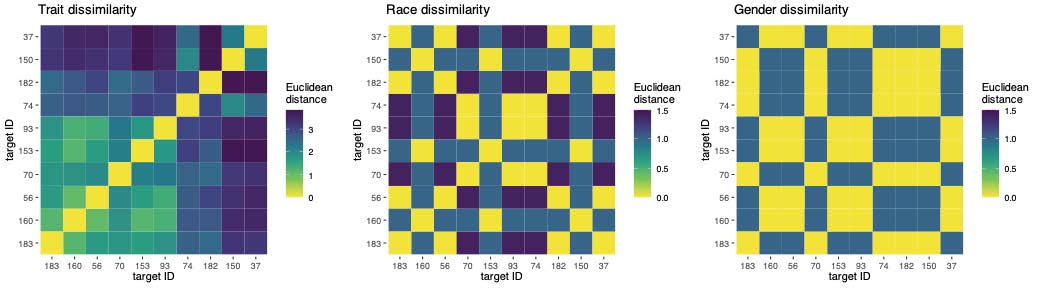
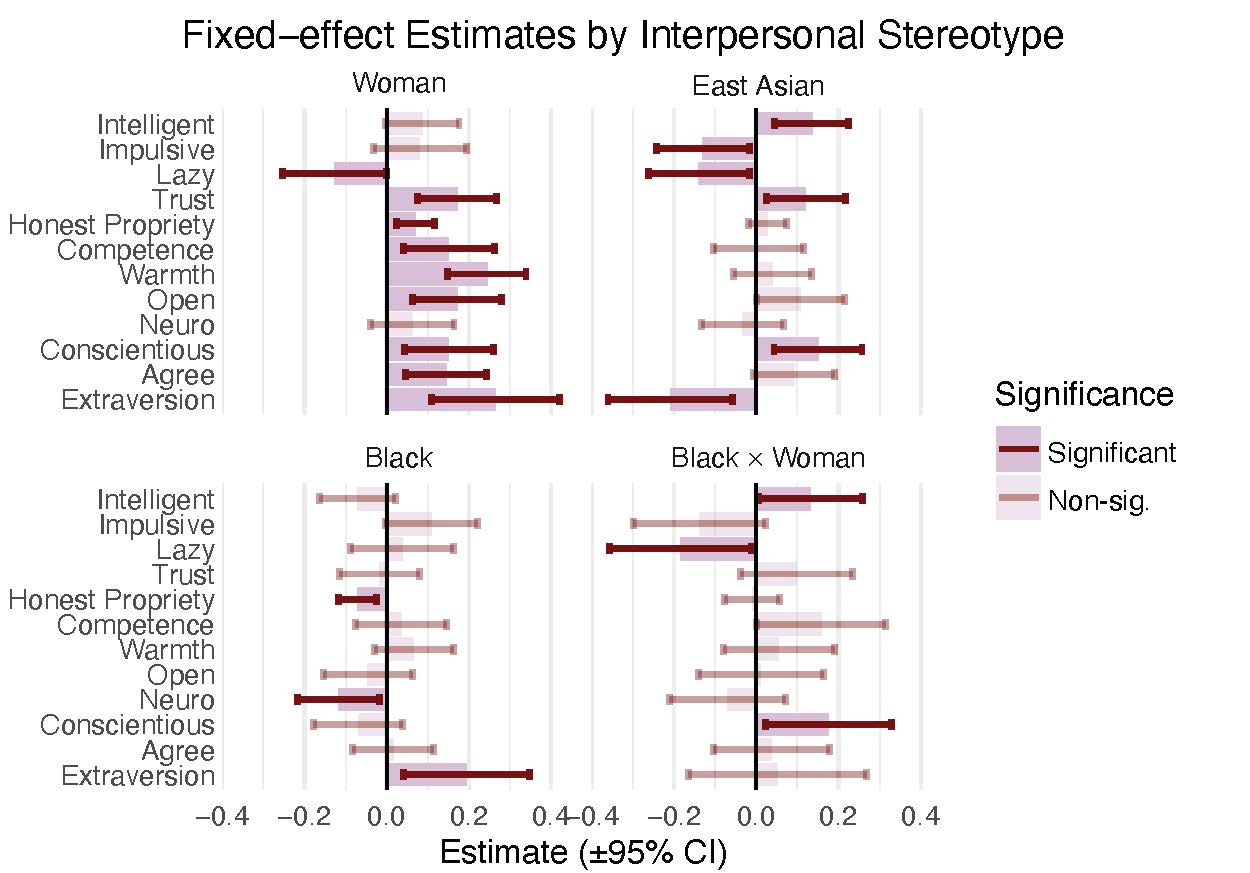
This project examines how race and gender stereotypes unfold in naturalistic contexts. Using Zoom-like video conversations, we tested whether perceivers formed “clustered” impressions of intersectional identities (e.g., Black women, Asian men) across personality traits and stereotype content domains. We then examined which traits drove these impressions and how they shape downstream judgments like sympathy, affiliation, and credibility, revealing how bias operates at the level of individuals, not just group labels. Manuscript under review (Jacobson, Hughes, & Chavez).
Key idea: Trait impressions are biased by intersectional identities that are additive or distinctly hybrid; and they are interpersonally consequential.
Project 2 — Ethnoracial Ambiguity
When people form first impressions, they often rely on category-based expectations, but racially ambiguous individuals challenge these shortcuts by defying easy classification. This project examines how perceivers form trait impressions of racially ambiguous targets (including multiracial, Latine, and South/Southeast Asian individuals) in naturalistic, video-based interactions. We also examine whether individual differences across perceivers, such as racial essentialist beliefs, interracial exposure, and childhood neighborhood diversity, predict the extent to which impressions rely on racial schemas versus individualized cues.
Key idea: How people perceive racially ambiguous individuals may depend on whether they rely on racial schemas or individuated cues, and this likely varies by perceivers’ beliefs and lived experience.
Project 3 — Socioeconomic Status
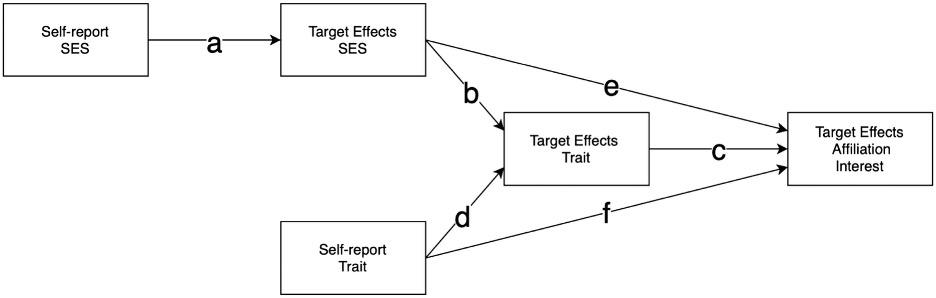
This project examines how socioeconomic status shapes first impressions and credibility judgments during real-world social interactions. In a computer-mediated round-robin study, U.S. adults engaged in brief dyadic conversations and then rated their partners’ SES, personality traits, and credibility. This approach reveals how SES detection and SES-based stereotyping operate in everyday interaction, and how these processes may perpetuate inequality. Published in Journal of Personality & Social Psychology (Hughes, Jacobson, Rule, & Srivastava, 2025).
Key idea: SES shapes trait impressions in social interactions.
Project 4 — Political Affiliation & Religiosity
This project examines how political ideology and religiosity shape impression formation as interpersonal stereotypes in everyday interactions, guiding how people are perceived and who others want to affiliate with, even when these identities are not explicitly stated. The study draws on two undergraduate samples and one U.S. adult sample (Ns = 224, 151, 297). Manuscript under review (Hughes, Jacobson, Pearman, Hamid, Rule, & Srivastava).
Key idea: Political ideology, and less strongly, religiosity, shapes everyday social interaction, guiding first impressions and who people choose to connect with, even when politics is never discussed.